
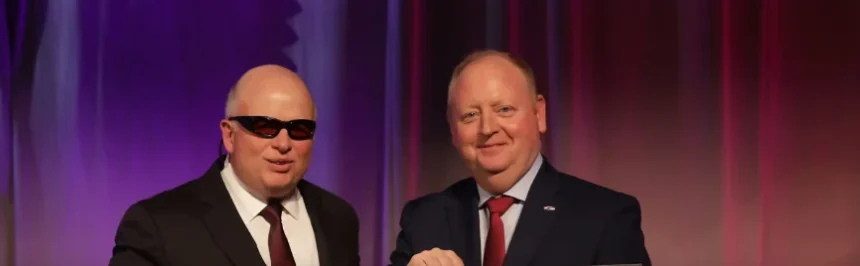
In a world where constraints tend to dictate the route of an individual, one man is redefining the story. John O’Connell of Toms River, New Jersey, is legally blind, but that has not stopped him from tying his skates, picking up his equipment, and riding it through various forms of transportation every week and getting into the rink. As part of his recognition of his outstanding efforts, he has been recently named as USA Hockey Disabled Athlete of the Year, which is a good reward for his hard work, his passion, and his mission both on and off the rink.
Between Toms River and the Ice Rink.
All practices start way before the initial confrontation. John wakes up early, takes a hockey bag and a stick, and walks to a bus stop in Toms River. Then he boards a bus, which transports him to Penn Station in Manhattan, a train, which takes him to Newark, and finally, he takes a ride in an Uber, which takes him to the Bridgewater Ice Arena. He has taken up to four hours of commute by the time he gets on the ice, and no one can commit four hours of commute in the name of recreation.
However, this is not about convenience. To John, it is about bondage, belonging, and passion to the game. He moves through his world with precision, with a white cane tapping in front of his eyes, which are covered by sunglasses. It is not a small accomplishment, the trip, but it is the start of what proves to be a routine that goes against the grain.
Service, Blindness, and the Ice Come Together.
John’s path hasn’t been easy. He had over 23 years of service in the U.S. Air Force, during which he used to engage in humanitarian services throughout the globe, and these experiences helped him develop his worldview and purpose. This service, along with his affection for hockey, made a special story: a story that could be related to discipline, courage, and strength.
John started to lose sight in his 50s. What began as simple minor problems with reading turned into a diagnosis that changed the day-to-day life of the involved person: almost perfect blindness at night and near-zero peripheral vision. Many would step back. John stepped forward. He did this not because he had lost interest in the game he adored, but because he had lost his vision and therefore was unable to play hockey.
He has been playing in the NJ Warriors, which is a program where veterans with disabilities get the opportunity to play. He expected to be a spectator. Instead, he was named the second-line left wing and was thrown back to the flames of rivalry in the sport of hockey. Going back to the ice was not a hobby anymore, but a lifeboat.
Why John’s Story Resonates
- Severe perseverance: The fact that it is several hours of travel, a physically demanding sport, and he can no longer see, makes his engagement an extraordinary display of perseverance.
- Reinventing ability: John disproves the expectations of what people with vision loss can accomplish. Once you become blind, everyone reminds you about the things you are not able to do, he says. However, with John, it is about saying what you can.
- Community and service: He did not end with playing. John is a commissioner of the Blind in the State of New Jersey and a member of the board of the Blinded Veterans Association. His voice extends outside the rink because of his efforts to promote transportation availability and adaptive sports.
- An uplifting tale across all ages: The story is not only inspirational to athletes or veterans, but it is a message to anyone who is struggling. It could be sight, age, or any kind of challenge, and John proves that passion and perseverance pay.
What the Award Means
To have received the title of the Disabled Athlete of the Year by the USA Hockey is much more than a trophy. To John, it was a reminder of the usefulness of being noticed. Like a blind man, you are not seen in the world… It is only pleasant that someone knows who you are. That somebody sees you.” The award is not an endpoint; it is a light on a path of continuing inspiration.
Looking Ahead
John may not be playing in the NHL or skating before millions of people- but in his world, he is playing at the top. He intends to continue appearing, training, promoting, and demonstrating that the ice is open to everyone bold enough to skate. His point is plain: lace up, present, and open.
Final Thoughts
What John O’Connell lacks is not the definition of his life, but the things he seeks. With each trip, each time he goes out on the ice, every board he fights to get out of, he is rewriting the book of what can be done. Well deserved is his award, but better still, his example is priceless. You are a veteran or athlete, parent or student, the road to which says this: you may be faced with obstacles, but that does not mean that you should give up on your ambition. They highlight it.